Photographer's Notes
Gallery Sixteen, Sacred Vessel
<Return to Gallery Sixteen> <Return to Page 1>
 Warming Up
(Curtis Photo) |
Preparation
Being principally a nature and landscape photographer, I don't have a studio, so it was necessary to rent studio space at the art school and work out a schedule. Unfortunately, it would be several weeks between the time I interviewed Nichole and we could begin the first photo session. I spent some of that time viewing videos of Odissi dancers and in acquainting myself as much as possible with this art form. By researching the Odissi positions and watching videos of the dancers, I hoped to add to my ideas about the kind of poses I wanted. Doing this research also helped me to better understand Nichole as someone with a passionate commitment to classical Indian dance. As the vessel and earthly representative of the soul, it seemed best to isolate Nichole's body as much as possible from any hint of the material world. To this effect I had already planned to drape the floor and background of the studio space in black cloth. Although the pictures were shot in color, it was my intent to turn the whole series into black and white images. As it turned out, some of the images simply refused to be black and white, but it gave me an opportunity to think ahead about the kind and amount of lighting I would need. While I wanted to celebrate an archetypal idea about the body, as a photographer I also wanted to explore the effect of light, the angle of light and it's intensity upon the human form. Being in the habit of viewing landscapes in the low angle light of early morning and late afternoon, I prefer the drama and mystery created by high contrast scenes with deep shadows. The tungsten filament found in incandescent lamps produces a very warm, distinctly red light, and I decided to use incandescent lamps placed at low angles for the nude images. Even though most of the images were to become black and white, the warmth would still be communicated by tonal variatons. Image #035 seen <here> shows the light's color temperature without correction. |
| Two,
3-hour photo sessions were scheduled in late November and early
December. Although it may not be apparent from the photographs,
our room was cold, and it was necessary to take breaks to allow Nichole
to don her robe and warm up by a space heater that she brought in
specifically for this purpose. Prior to the sessions, Nichole warmed
her muscles and relaxed them by performing some Odissi dances, while I
shot hand-held candids as seen above left. Experienced photographers will notice
immediately that the image above was not exposed under low
wattage incandescent lamps. A high angle 500-watt quartz flood (placed above
and to Nichole's left) was used together with a hot shoe mounted,
bounced fill flash and secondary AC slave, all of which were necessary
to provide sufficient light to stop action. As they say, "time is money," so two days before our first session, I rehearsed light placement and metering in my livingroom, using my old cat, "Candy," Image #063 Gallery Four, as a subject. After experimenting with the lights, it became apparent that the high contrast use of a black background together with a fair-skinned model and low level incandescent lighting would hopelessly confuse the internal metering systems in my cameras. Consequently, I made the decision to turn off the metering in the cameras and to use a hand held light meter and bracketed exposures for all of the nude images. Classic nude photographer Ruth Bernhard would literally spend hours setting up a pose, changing lights, focusing, reading exposures and making camera adjustments before actually tripping the shutter on her large format film cameras. The reasons were both practical and asthetic. Large format film is very expensive, and the cost of multiple exposures adds up quickly. Large format cameras have adjustable front and rear standards connected by a light tight bellows. By making small adjustments to the tilts and swings of these standards, the photographer can have considerable control over the angle at which the light from a lens will strike the film plane, and It is possible to dramatically control both perspective and depth of field by doing this. The disadvantage is, of course, the time investment in making the necessary adjustments with large format. Although I didn't use large format, this collection is an homage to Bernhard who's work I admire greatly. |
Image Capture and Printing Since
I wanted to explore a variety of poses, speed was a concern. Large
format was out, and
I decided to use a pair of Canon digital SLRs with zoom lenses, backed
up by my old, Mamiya RB67 SD Professional. The Mamya is a
medium format film camera and would provide a good backup to the DSLRs
if needed. Depth of field with the DSLR equipment in low
level
lighting and with a black background could be a concern, however. A rather slow ISO of 200 was selected to reduce DSLR noise,
and in the interest of
optimal depth of field and optical clarity, virtually all images were
shot at between f5.6 and f11 at short focal lengths. This meant
that shutter speeds would need to be quite slow,
and a number of images were, in fact, captured at between 1/5 to 1/15 of a
second.
Camera motion was managed with the use of a tripod.
Subject motion at such slow shutter speeds was managed beautifully by the subject herself. I was impressed with Nichole's ability to hold her body virtually motionless for extended periods of time, aided no doubt by the twin disciplines of Yoga and Odissi. About 20 exposures were taken of the pose at right while lights were moved, light levels were read and camera adjustments made in between. Note that Nichole was balanced on the balls of her feet with her arms extended for these shots, yet virtually no subject motion was detectable in the images, even at shutter speeds as slow as one fifth of a second. At times Nichole was required to hold this position for up to a full minute. If you think that sounds easy, try it yourself about 20 times in a row. |
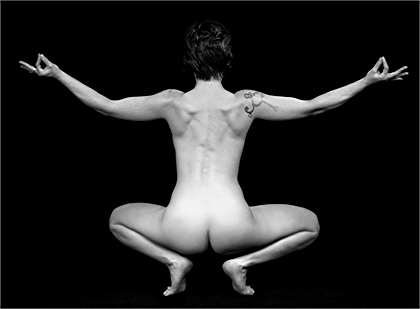 Image #022
(Curtis Photo) |
| I
think that Image #022 at right is probably my favorite of the
series, partly because of the technical difficulty required by
both the photographer and the model, and partly because of the
uniqueness of the pose. Although I believe that I have seen this pose
done elsewhere, I have unfortunately been unable to find it
and would appreciate hearing from anyone who could direct me to a
publication in which it appears. For the print, I kept Nichole's
elegant shoulder tatoo, although I have removed it in a number of other
exposures. The tatoo compliments the thumb and fore finger mudras and also helps to break up
the overt symmetry of the image. As with all of the prints in Gallery Sixteen, I used multiple Photoshop layers with contrast masking, color channel manipulation and Levels adjustments to pull out the detail I wanted in highlights and shadows. By boosting or reducing color intensity beneath a monochrome layer, considerable control can be exerted over the range of grey scale tones. Being someone who originally started making prints in a photo lab, I regularly find myself putting the final touches on an image with dodge and burn tools. It is probably a habit I will never give up. I used dodge and burn to put just a bit more definition in Nichole's back and leg muscles in the image above right. |
<Return to Gallery Sixteen> <Return to Page 1>
Please send comments to Jay@CURTISPHOTOGALLERY.COM